1. Global FX markets at a glance
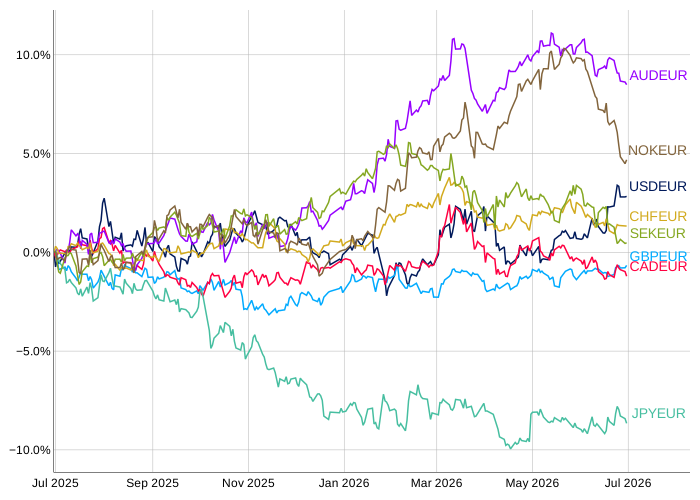
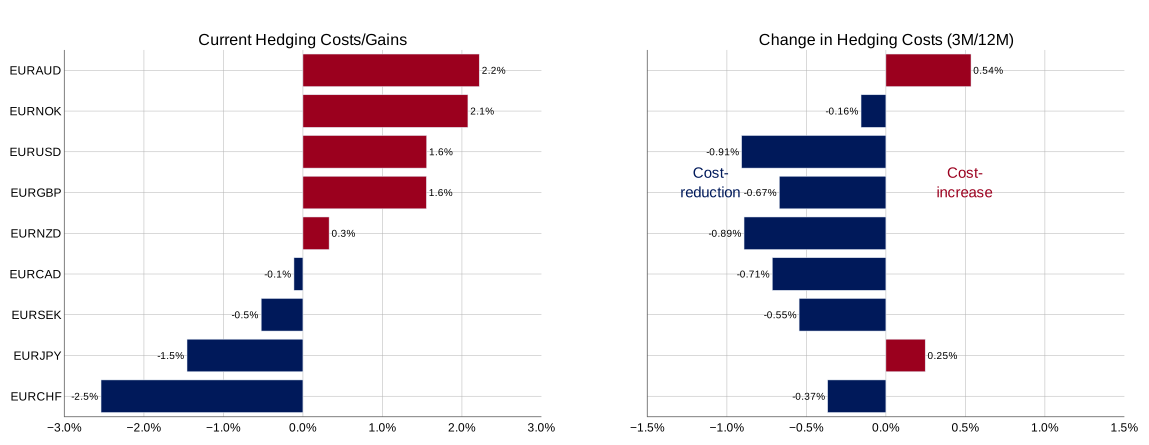
Figure1: Indexed exchange rates against the euro over the past 12 months (top chart), annualised hedging costs for a 3-month hedge (bottom left chart) and the 12-month change in the annualised 3-month hedge (bottom right chart)
(Source: Bloomberg, 7orca – own illustration)
At the start of the second quarter of 2026, the structural drivers in the G10 foreign exchange market have continued to shift. The euro’s strength seen in 2025 has now largely been eroded: both traditional ‘safe-haven’ currencies such as the CHF and USD, and commodity currencies such as the AUD and NOK, have appreciated against the euro year-on-year (see Figure 1, top chart).
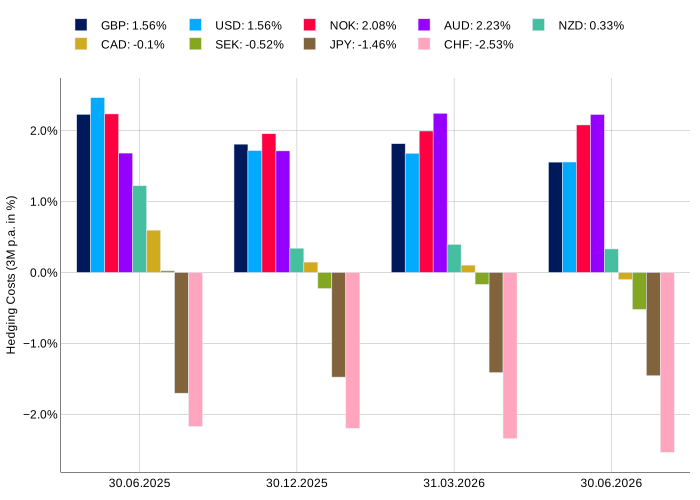
The key factor behind this is the escalation in the Middle East, which has forced a recalibration of monetary policy paths via rising commodity prices and supply chain disruptions. For commodity-exporting economies, a rise in oil and gas prices acts directly as a positive terms-of-trade shock: export revenues rise, current account balances improve, and domestic price pressures increase – a scenario that puts central banks such as the Royal Bank of Australia and Norges Bank under pressure to act. Australia has already responded with two interest rate rises of 25 basis points each, resulting in the highest hedging costs within the G10 for EUR/AUD, currently at around 2.2 per cent.
At the other end of the hedging spectrum, EUR/CHF (-2.5 per cent) and EUR/JPY (-1.5 per cent) remain the most attractive sources of hedging returns. As geopolitical tensions gradually ease – as suggested by the recent signal of a US-Iranian ceasefire – many of the expectations of interest rate rises that have built up recently are likely to be gradually priced out of the market. As this applies disproportionately to the eurozone, it is likely to cause hedging costs to rise on average.
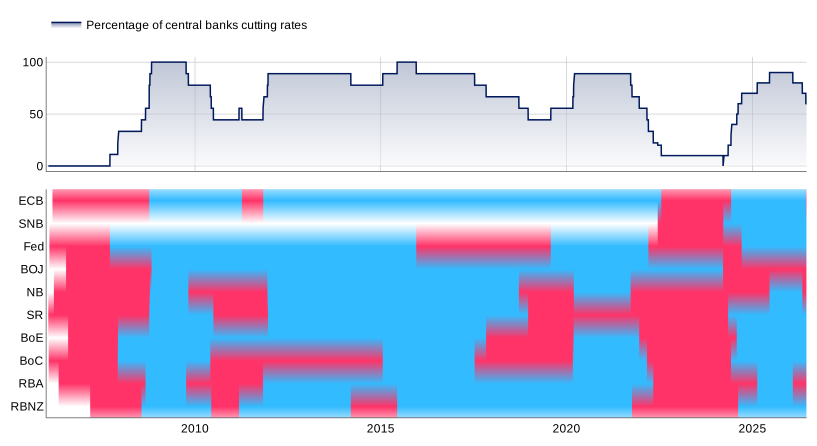
Figure 2: Central bank activity; the red area illustrates the start of an interest rate rise (including the subsequent period during which rates are held steady), whilst blue represents the start of an interest rate cut (also including the subsequent period during which rates are held steady)
(Source: Bloomberg, 7orca – own presentation and calculation)
The global central banking landscape is currently experiencing a phase of marked desynchronisation. The synchronised cycle of interest rate cuts that had emerged from 2024 onwards has lost much of its coherence as a result of the energy price shock (see Figure 2).
The situation in the eurozone is more nuanced. Although the ECB has recently raised interest rates, it is doing so against a backdrop of conflicting factors: the inflationary pressure is coming from outside via rising import prices, whilst the eurozone’s structural growth potential remains low. With a de-escalation in the Middle East and the associated fall in energy prices, the further ECB rate rises currently priced into the market are therefore likely to be priced out again – the low level of domestic growth simply does not provide an economic basis for a sustained restrictive stance.
By contrast, the Fed, under its new chair, has sent a clear signal.
At its meeting on 17 June 2026, the key interest rate was unanimously left within the target range of 3.5% to 3.75% – and the tone is significantly more ‘hawkish’ than many had expected. After years in which the 2 per cent inflation target was systematically missed, price stability is once again the undisputed focus of the Fed’s communications. This change of course is not solely driven by economic factors, but also has an institutional dimension: Warsh has been tasked with restoring the Fed’s credibility – and that requires staying power in the fight against inflation.
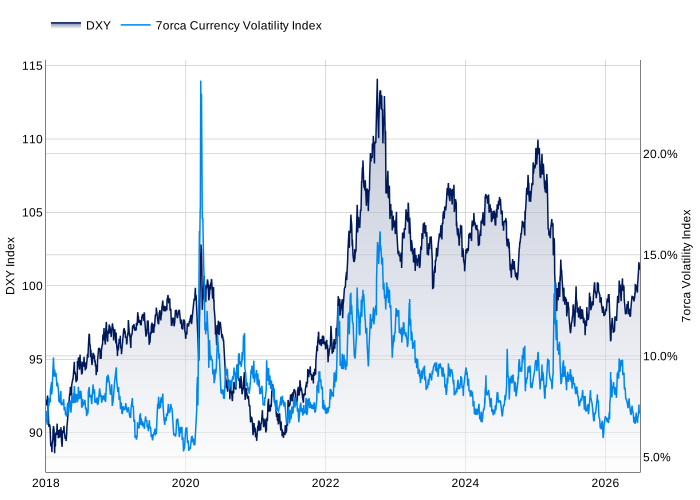
Figure 3: US Dollar Index (DXY) vs. 7orca FX Volatility Index1
(Source: Bloomberg, 7orca – own presentation and calculation)
1The 7orca FX Volatility Index approximates the ‘fair’ value of a variance swap by replicating a plain vanilla options portfolio in the G10 currency market. The resulting indices are averaged. A higher value indicates greater volatility in the foreign exchange market.
The US Dollar Index (DXY) has presented a mixed picture so far this year. Following the sharp decline in 2025, which was largely attributable to a loss of institutional confidence and a perception that the Fed was becoming increasingly politicised, the US dollar recovered noticeably in the first quarter of 2026 amid the escalation of tensions with Iran. The announcement of a ceasefire has recently dampened this momentum somewhat, without significantly altering the structural picture. Warsh’s hawkish comments have recently provided a significant boost to the DXY in the second quarter of 2026. The development of volatility in the currency market is particularly noteworthy. The 7orca FX Volatility Index is at a historically low level – with the exception of two brief spikes on so-called ‘Liberation Day’ and at the start of the escalation in Iran – a situation last observed in 2018. Both volatility spikes were quickly sold off, suggesting that the market has so far classified geopolitical risks as temporary and manageable. However, given the ongoing unresolved conflict in the Middle East and a desynchronised central banking landscape, this calm appears fragile – historically, such periods of unusually low volatility have rarely been long-lasting.
2. Europe and the US
“That is the Federal Reserve's long-held objective of 2%. The 'two' is the left of the decimal point. For now, 'zero' is to the right.“ Kevin Warsh (17 June 2026)
2.1 Monetary policy & exchange rate trends
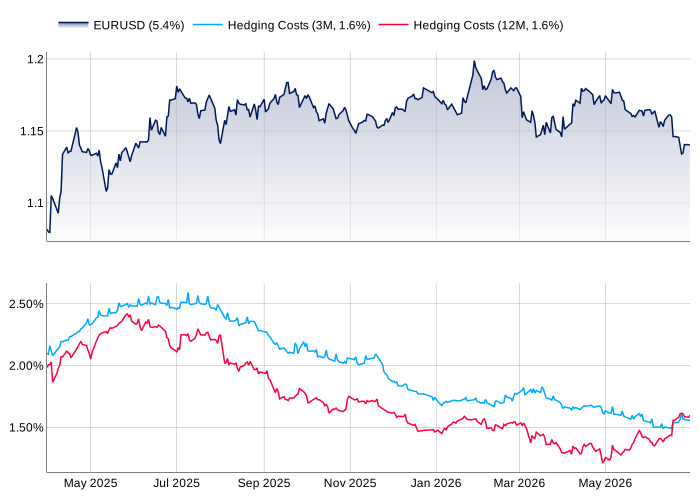
Figure 4: EUR/USD exchange rate and hedging costs
(Source: Bloomberg, 7orca – own illustration)
During the period under review, the EUR/USD traded largely sideways within a range of 1.13 to 1.18. As tensions in the Middle East escalated and safe-haven demand set in, the currency pair recently came under pressure. Hedging costs for the 3-month tenor have risen to 1.6% – reflecting reduced expectations of Fed rate cuts – whilst 12-month hedging costs have fallen to 1.2% at times, reflecting the temporary rise in expectations of ECB rate hikes. Meanwhile, the 3-month and 12-month rates have converged to around 1.6 per cent — a sign that the market is pricing in virtually no movement in the interest rate differential over the entire horizon.
The FOMC meeting on 17 June was marked above all by a shift in communication strategy: Warsh explicitly moved away from forward guidance. The statement was significantly shorter than those previously issued under Jerome Powell. He explained that forward guidance was not suitable for the current monetary policy environment: “It’s a bit shorter, a bit simpler and it dispenses with some older language.” He pointed out that the markets should serve as signal-givers for the Fed, rather than the Fed driving the markets. This break with the previous communication approach is not merely cosmetic: it structurally increases uncertainty regarding the future monetary policy path, but leads to markets that are less distorted by monetary policy decisions.
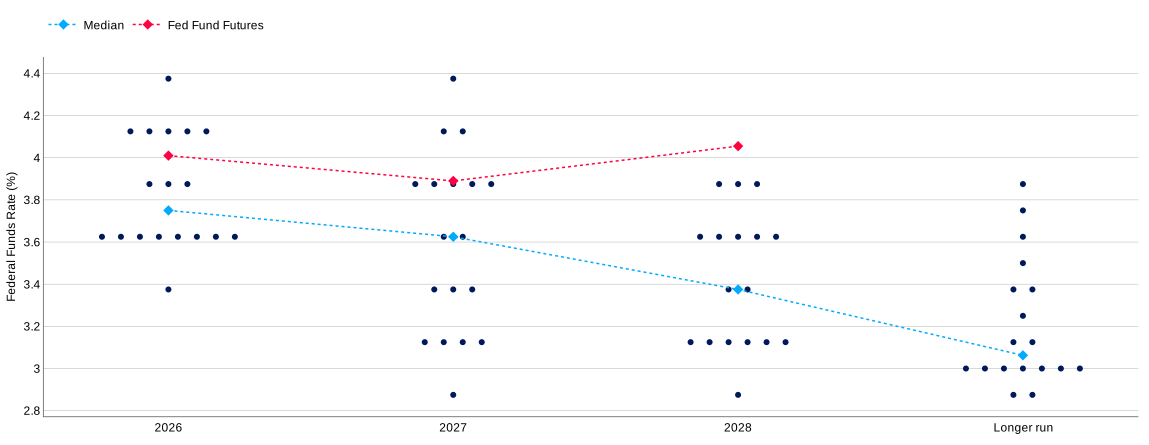
Meanwhile, the median in the dot plot for the end of 2026 shifted to 3.8 per cent – up from 3.4 per cent in the March projections and thus a quarter of a percentage point above the current policy rate corridor. Around half of the FOMC members are projecting an interest rate rise for 2026. This is a far cry from what one might have expected from a Trump-aligned adviser at the helm of the Fed. Warsh made it unmistakably clear that the 2% inflation target is not up for debate: “The ‘two’ is to the left of the decimal point. For now, ‘zero’ is to the right.” It is worth noting here that Warsh himself refrained from making his own projection — a deliberate signal that he wished to emphasise the independence of his assessment from the dot plot mechanism.
Figure 5: Dot plots from the Fed’s Summary of Economic Projections.
(Source: Fed, Bloomberg, 7orca – own illustration)
On the euro side, a counter-movement is emerging as geopolitical tensions ease. Although the ECB raised interest rates by 25 basis points at its last monetary policy meeting, the macroeconomic fundamentals for a sustained more restrictive stance are lacking: the eurozone’s growth potential remains structurally low, and the inflationary impulse was primarily energy-driven and thus exogenous. As pressure from energy prices eases, the further rate hikes currently priced in are likely to be gradually priced out – which would shift the interest rate differential in favour of the dollar and weigh on EUR/USD in the medium term. Overall, the risk distribution therefore remains asymmetrical in favour of the USD: in the short term due to safe-haven dynamics, and in the medium term due to macroeconomic divergence.
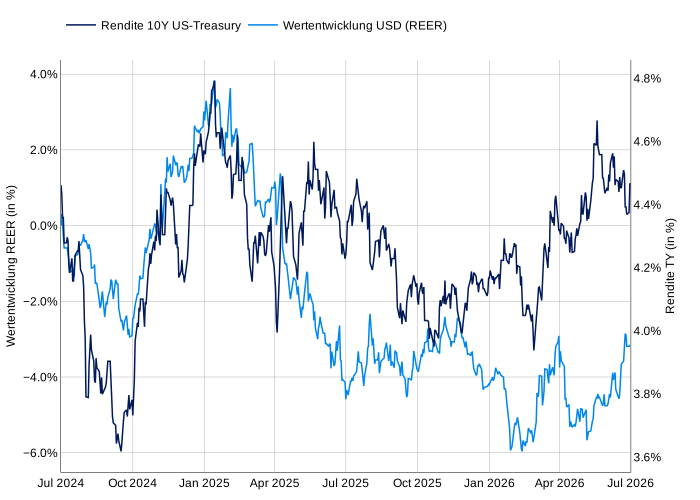
Figure 6 illustrates a trend that had already been identified as a structural anomaly in the Q4 2025 report: the historically stable positive correlation between US bond yields and the dollar in real effective terms (REER) has dissipated over much of the past year. Rising 10-year yields were at times accompanied by a depreciation of the REER – a sign that it was not interest rate levels, but fiscal risk premiums and confidence factors that were driving the exchange rate.
It is only with the recent geopolitical escalation that a closer alignment between the two time series has re-emerged. The return to the classic safe-haven dynamic is a reassuring sign for the US dollar.
Structurally, however, the ‘term premium’ at the long end of the US yield curve is likely to continue rising. Warsh announced five working groups tasked, amongst other things, with reviewing the Fed’s balance sheet structure. A shift away from mortgage-backed securities towards shorter-dated securities would reduce demand for duration at the long end and gradually increase the term premium. For the REER, the key question remains the same as in 2025: will rising yields be interpreted as a sign of monetary policy credibility – which supports the US dollar – or as a sign of fiscal uncertainty, which would reverse the correlation once again. Under Warsh, the signals so far tend to point to the former: a Fed that consistently prioritises inflation and demonstrates communicative independence gives the market reason to interpret rising yields once again as a monetary policy signal – rather than as a risk premium.
Figure 6: Yield on 10-year US government bonds (TY) vs. USD Real Effective Exchange Rate (REER)
(Source: Bloomberg, 7orca – own illustration)
2.2 Economic Outlook
The economic divergence between the US and the eurozone deepened further in the first quarter of 2026, continuing a trend that has been structurally consolidating since 2024. Real US GDP grew at an annualised rate of 2% in the first quarter – a remarkable recovery following a weaker end to 2025, which underlines the robustness of the US domestic economy. The Summary of Economic Projections (SEP) dated 17 June 2026 confirms this picture: The median forecast for US growth stands at 2.2% for 2026 as a whole and remains unchanged at 2.3% for 2027. With a projected unemployment rate of 4.3%, the labour market remains close to full employment; real wages are outpacing inflation despite rising price levels – private consumption thus continues to drive the expansion.
By contrast, the eurozone finds itself in a fundamentally different state. Following a revision, it recorded a 0.2% decline in real GDP in the first quarter of 2026 – the first contraction since the fourth quarter of 2022. Year-on-year, growth stands at just 0.3%. The ECB’s June 2026 projections revise the growth forecast for the year as a whole to 0.8 per cent – a figure that very accurately captures the fundamental structural nature of the eurozone. The growth gap with the US – just under 1.5 percentage points based on the projections – is more than just a cyclical phenomenon: it reflects different economic structures, different fiscal policies and varying degrees of resilience to external shocks.
Within the eurozone, the picture remains mixed. Whilst Spain, at 0.6 per cent, once again leads the growth momentum among the major economies, Germany and Italy, at 0.3 per cent each, are showing positive development compared with previous quarters – but are not providing any structural impetus. Germany’s recovery remains fragile: growth of 0.3 per cent following two years of chronic growth weakness does not signal a turnaround, but rather stabilisation at a low level. The positive contribution to growth from fiscal reforms is now barely measurable.
For EUR/USD, this divergence in growth has a direct macroeconomic implication. A US economy growing at a solid pace, with its central bank adjusting its interest rate path upwards, stands in contrast to a eurozone that is structurally weak and whose scope for monetary policy has been narrowed by an exogenous inflationary impulse – not by domestic demand. The interest rate differential in favour of the US dollar is therefore not merely a monetary policy phenomenon, but has a robust economic foundation.
2.3 Price trends
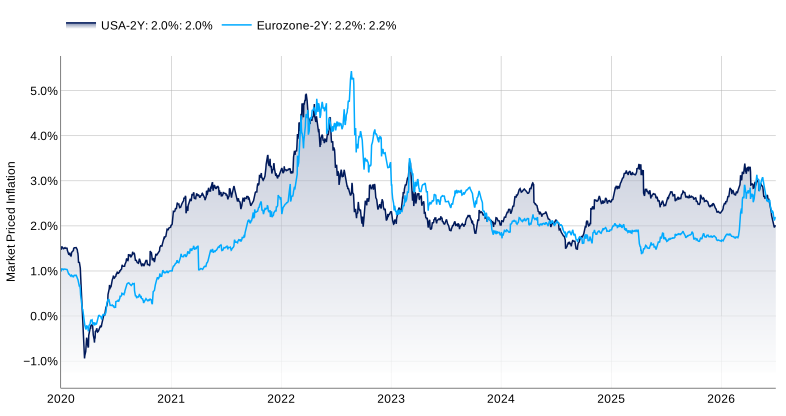
Figure 7: Market-priced inflation rates in the US and the eurozone (2-year horizon)
(Source: Bloomberg)
Figure 7 illustrates a remarkable convergence in market-implied inflation expectations over a 2-year horizon. Whilst US expectations have remained within a range of 2% to 3% since mid-2023 – and thus persistently above the Fed’s target – the eurozone has recently caught up: Market-implied
2-year inflation rates, at around 2.5%, are at their highest level since the energy price shock of 2022/2023 – and, for the first time in years, are once again on a par with those in the US.
However, the causes of this convergence are asymmetrical. In the US, the elevated level reflects structurally entrenched inflationary dynamics, which have preoccupied the Fed for years and which, under Warsh, have now explicitly become the focus of monetary policy. In the eurozone, by contrast, the rise is primarily driven by energy prices – an exogenous shock that is likely to subside again as tensions in the Middle East ease. The similarity in levels thus masks a fundamental difference in character: persistent on the one hand, transitory on the other.
This has a clear implication for the exchange rate. Should eurozone expectations fall back as energy price pressures ease, whilst those on the US side remain at elevated levels, the real interest rate differential will widen in favour of the US dollar – thereby providing a further structural argument for USD strength, irrespective of safe-haven flows.
2.4 Overall assessment of EUR/USD
The structural arguments in favour of a stronger dollar have become even more compelling. Growth divergences, a ‘hawkish’ recalibration of the monetary policy framework and the Fed’s regained institutional credibility stand in contrast to a eurozone that contracted in the first quarter and whose central bank has raised interest rates to curb growth – not because of excessive domestic demand. With energy price pressures easing, the ECB is unlikely to find much justification for maintaining a restrictive stance, whilst the Fed has only just embarked on such a course. The interest rate differential is thus widening in both directions – driven by economic fundamentals that were still lacking in 2025. Overall, the downside risks for EUR/USD predominate: in the short term due to safe-haven dynamics, and in the medium term due to divergences in growth, monetary policy and institutional credibility.
3. United Kingdom
3.1 Monetary policy & exchange rate trends
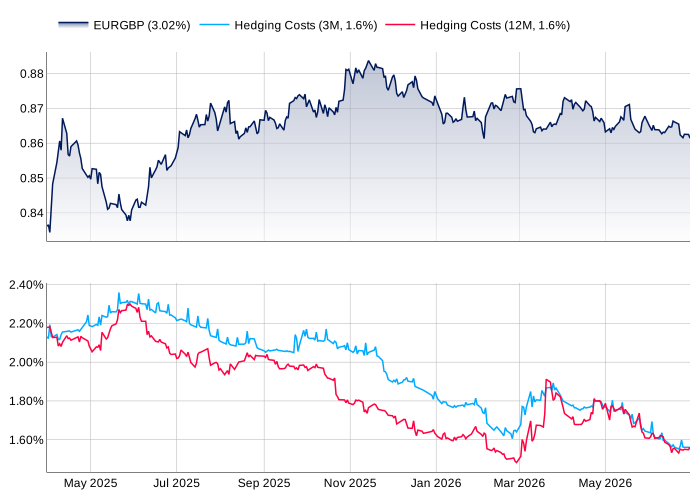
Figure 8: EUR/GBP exchange rate and hedging costs
(Source: Bloomberg)
The British pound has stabilised against the euro over the period under review. Following its high of around 0.88, the EUR/GBP exchange rate is now fluctuating more narrowly around the 0.865 mark – a level that signals neither clear strength nor pronounced weakness in the pound, but rather reflects the ambivalence of the fundamental situation (see Figure 8, top chart).
The trend in hedging costs is particularly striking. The 3-month and 12-month tenors have converged to around 1.6% and are now moving almost in parallel – a flat hedging structure that suggests the market is pricing in virtually no potential for interest rate changes for the pound over the entire horizon. The situation was different just a year ago: at that time, the significantly steeper curve reflected an interest rate advantage for the GBP, which provided at least some support for the pound. This stabilising factor has now largely eroded
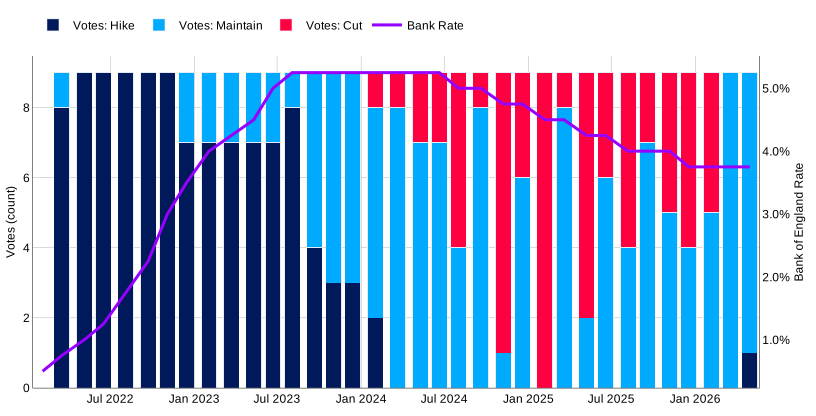
Figure 9: Voting patterns at the Bank of England
(Source: Bank of England)
The voting patterns within the Monetary Policy Committee tell a similar story (see Figure 9). After the Bank of England gradually cut its key interest rate to its current level of around 3.75 per cent, calls for a more restrictive stance have recently been on the rise again – a direct response to the energy price shock and the associated uncertainty surrounding inflation. The MPC thus finds itself in the same dilemma as the ECB: an externally driven inflationary impulse is colliding with a structurally weak domestic economy, which leaves little scope for a sustained more restrictive stance. The result is a more diverse range of views within the Committee, which is keeping the future direction of monetary policy open for the time being and increasing the British pound’s sensitivity to incoming data. For risk-averse investors, meanwhile, a significant reduction in hedging costs compared with the previous year is welcome news.
3.2 Economy
At first glance, UK GDP growth of 0.6% quarter-on-quarter in the first quarter of 2026 appears robust – a figure that significantly outperforms the simultaneous contraction in the eurozone. However, this interpretation calls for caution. The rise was largely driven by front-loaded consumer spending, which was brought forward in anticipation of rising energy prices and further cost increases due to the Iran conflict. This is not underpinned by any structural growth momentum.
This is evident in the labour market. The unemployment rate now stands above 5 per cent – a level last seen more than a decade ago. Wage growth in the private sector has cooled from around 6 per cent in the previous year to below 4 per cent and is likely to ease further. Consumption, which was the main driver of Q1 growth, is thus losing its financial foundation.
Structurally, the picture remains unfavourable. Investment is stagnating, private-sector profitability is low, and the government’s fiscal policy leeway is constrained by rising debt servicing costs. The OECD forecasts growth of just 0.9% for 2026 as a whole – a plausible estimate once the Q1 front-loading effect has subsided.
This paints a mixed economic picture for EUR/GBP: the British pound is not benefiting from superior growth momentum, but rather from a eurozone that is structurally even weaker. The economic data do not suggest any independent fundamental strength on the part of the pound.
3.3 Price trends
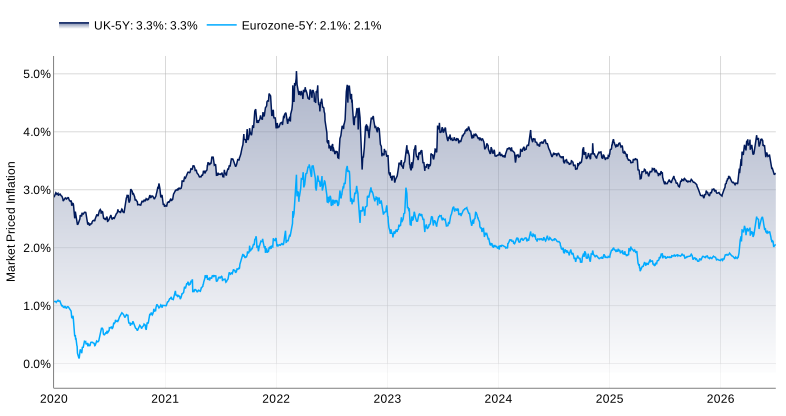
Figure 10: Market-priced inflation rates in the UK and the eurozone (5-year horizon)
(Source: Bloomberg)
Figure 10 highlights a structural feature of the United Kingdom: market-based inflation expectations over a 5-year horizon, currently standing at 3.3 per cent, are not only well above the Bank of England’s 2 per cent target, but have never sustained levels below 2.5 per cent since 2021. By comparison, euro area expectations, at 2.2 per cent, are far more firmly anchored to the inflation target – a finding that underlines the British economy’s structurally higher propensity for inflation and casts the Bank of England’s monetary policy credibility in an unfavourable light.
The latest inflation data confirm this picture. The Consumer Price Index stood at 2.8% year-on-year in May 2026 – in line with the previous month, but below market expectations of 3.0%. Beneath the surface, however, the picture is less encouraging: transport inflation accelerated to 6.8 per cent – its highest level since December 2022. This is largely driven by rising fuel prices in the wake of the Iran conflict. At the same time, core inflation rose slightly to 2.6% in May, whilst services inflation climbed to 3.7% – an indicator to which the Bank of England pays particular attention, as it is considered less susceptible to external factors and therefore more persistent.
This creates an uncomfortable situation for the British pound: an inflation pattern that remains stubbornly above target and flares up again quickly in the face of external shocks leaves the Bank of England little scope for rapid easing – without any momentum on the growth front that could provide fundamental support for the British pound
3.4 4 Overall assessment of EUR/GBP
The macroeconomic situation on both sides of the English Channel is more similar than the short-term GDP figures suggest. Structurally weak growth, an externally driven inflationary impulse and limited fiscal policy scope characterise both economies in equal measure. Neither the Bank of England nor the ECB has the economic foundation for a sustained restrictive stance – which makes interest rate hike expectations priced in on both sides vulnerable to corrections.
This is a favourable scenario for hedging costs. The already flat yield curve at around 1.6% is likely to ease further as energy price pressures ease and expectations of interest rate rises are gradually priced out of the market.
For the exchange rate itself, this paints a picture of relative stability. In the absence of structural growth divergences and clear divergences in monetary policy direction, the conditions for a sustained movement in either direction are lacking. EUR/GBP is therefore likely to remain anchored within a narrow range – the currency pair’s momentum will be determined less by fundamental drivers than by geopolitical developments and incoming inflation data.
4. Japan
4.1 Monetary policy & exchange rate trends
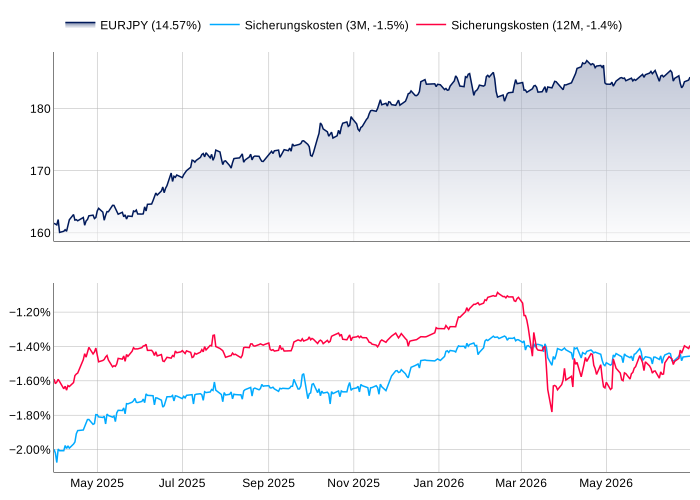
Figure 11: EUR/JPY exchange rate and hedging costs
(Source: Bloomberg, 7orca – own illustration)
The EUR/JPY exchange rate has appreciated by around 15% over the past 12 months and is thus trading at its highest level in decades – a finding that appears paradoxical at first glance. The Bank of Japan has gradually raised its key interest rate during the current cycle, thereby finally moving away from its long-standing negative interest rate policy. The yen has benefited very little from this in structural terms.
A look at hedging costs helps to explain part of this dynamic. At -1.5% for the 3-month tenor and -1.4% for the 12-month tenor, EUR/JPY continues to generate a significant hedging return – even though this has narrowed considerably from the low of around -2.0% earlier in the year. The trend around March 2026 is particularly noteworthy: hedging yields fell to just around 1 per cent on the 12-month tenor – a direct reflection of the expectations of interest rate rises in Japan at the time and consistent with a period of coordinated foreign exchange market interventions by the BoJ. The effect quickly fizzled out: both expectations and hedging returns fell again within a few weeks. The interventions did not break the structural depreciation pressure on the yen – at best, they temporarily halted it.
The reason lies in a structural dilemma that is unmistakably reflected in the Japanese government bond yield curve. Yields have risen markedly across all maturities – the 10-year yield stands at around 2.5 per cent, the 20-year at around 3.5 per cent and the 30-year now close to 4.0 per cent (see Figure 12). The steepness of this curve is not a neutral signal of a normal interest rate normalisation. It reflects a risk premium: investors are demanding a premium at the long end because the short end is being kept artificially low – not primarily due to inflationary dynamics, but because of the fiscal predicament. With gross debt exceeding 220% of GDP, an aggressive rise in short-term interest rates would increase the Japanese government’s debt servicing costs to such an extent that it would seriously jeopardise the sustainability of public finances. The BoJ is normalising – but it is doing so under fiscal oversight. Markets are responding with a steep yield curve: the longer the maturity, the higher the risk premium priced in to reflect this credibility issue.
This is an unfavourable scenario for the yen. Rising long-term yields support the yen when they signal monetary policy resolve. However, when they price in fiscal uncertainty, the effect is rather counterproductive – a pattern that was already observable with the US dollar in 2025 and which affects Japan even more acutely due to structural factors. For risk-averse investors, EUR/JPY therefore remains one of the most attractive sources of safe-haven returns within the G10 universe.
Figure 12: Yield curve in Japan

(Source: Bloomberg)
4.2 Economic Outlook
The Japanese economy proved surprisingly resilient in the first quarter of 2026. Real GDP grew by 1.8% on an annualised basis – following a downward revision of the initial estimate of 2.1%, but well above market expectations of 1.3%. The growth momentum was broadly based: private consumption strengthened, public investment rose for the first time in three quarters, and foreign trade made a positive contribution to growth thanks to rising exports.
However, the revision highlights the fragile foundations of this upturn. The main driver of the downward revision was a 0.7% slump in business investment – instead of the rise originally reported – due to weak investment in software and production machinery. This shows that growth was underpinned by fiscal stimulus and consumption-driven demand, not by a revival in business investment momentum. Higher borrowing costs and declining business confidence are dampening the willingness to invest – a direct reflection of the BoJ’s more restrictive policy.
The outlook is clouding over. According to estimates by leading economic research institutes, real GDP growth in the second quarter of 2026 is likely to turn slightly negative – at an annualised rate of -0.3 per cent – as the effects of the Iran conflict on energy prices, supply chains and private consumption become increasingly evident.
For EUR/JPY, this paints a mixed economic picture. A Japan whose growth trajectory is already losing momentum even before the full impact of the energy price shock is felt, and where corporate investment is declining despite nominally solid GDP figures, provides the BoJ with no economic tailwind to accelerate its normalisation course.
4.3 Price trends
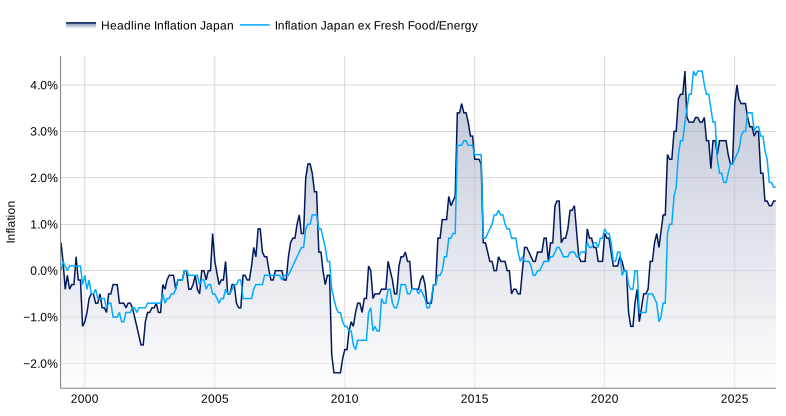
Inflation dynamics in Japan reflect the Bank of Japan’s structural dilemma in a concentrated form. After decades in which deflation was the defining monetary policy issue, headline inflation has stubbornly remained above 2% since 2022 – reaching levels of over 4% at the height of the global energy price shock in 2023 (see Figure 13).
Figure 13: Inflation and core inflation in Japan
(Source: Bloomberg)
The short-term picture is deceptively reassuring. Headline inflation has recently fallen to around 1.2 per cent – driven by the partial decline in energy prices following signs of geopolitical détente. However, core inflation – excluding ‘fresh food and energy’ – and energy, which is regarded as a structurally more robust indicator, remains at around 2.0 per cent, a level that is historically considered unusually high in Japan. It is noteworthy that this figure has not fallen consistently below the 2% mark for over two years now – a pattern last observed in the mid-1990s.
For the BoJ, this marks a fundamental turning point: the inflation target is no longer a target to be achieved, but a threshold that must not be exceeded on a sustained basis. This reversal of the monetary policy landscape justifies the chosen path of normalisation – yet at the same time it limits it. Core inflation that stubbornly hovers close to the target without clearly overshooting it provides no basis for aggressive tightening. Combined with the fiscal pressure forcing the BoJ to keep a close eye on the long end of the Japanese government bond yield curve, this results in a narrow corridor for monetary policy manoeuvre: normalisation, yes – but gradually and under the supervision of public finances.
For EUR/JPY, this means that the structural depreciation pressure on the Japanese yen remains intact. As long as the BoJ is unwilling or unable to substantially accelerate its interest rate path, the currency lacks the monetary policy foundation for a sustained appreciation – regardless of whether inflation data would nominally justify it.
4.4 Overall assessment of EUR/JPY
The analysis paints a consistent picture: the structural conditions for a sustained appreciation of the yen are not currently in place. The BoJ is normalising policy – but under fiscal oversight and without the economic tailwind that would justify accelerating the interest rate path. Foreign exchange market interventions can only temporarily alleviate the structural depreciation pressure. With the Iran shock – which, via rising energy prices, is having a direct impact on an economy with few natural resources – growth is likely to slow significantly in the second quarter.
EUR/JPY therefore remains an attractive source of returns within the G10 universe.
5. Data overview
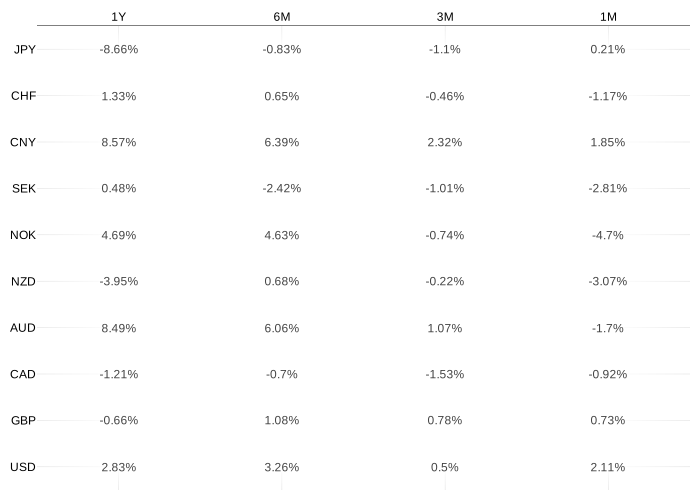
Figure 14: Overview of performance against the euro on various reference dates
(Source: Bloomberg, 7orca – own presentation)
Figure 15: Overview of hedging cost trends against the euro on various reference dates
(Source: Bloomberg, 7orca – own presentation)
Source and data set for all information, unless otherwise stated: 7orca Asset Management AG (30 June 2026)